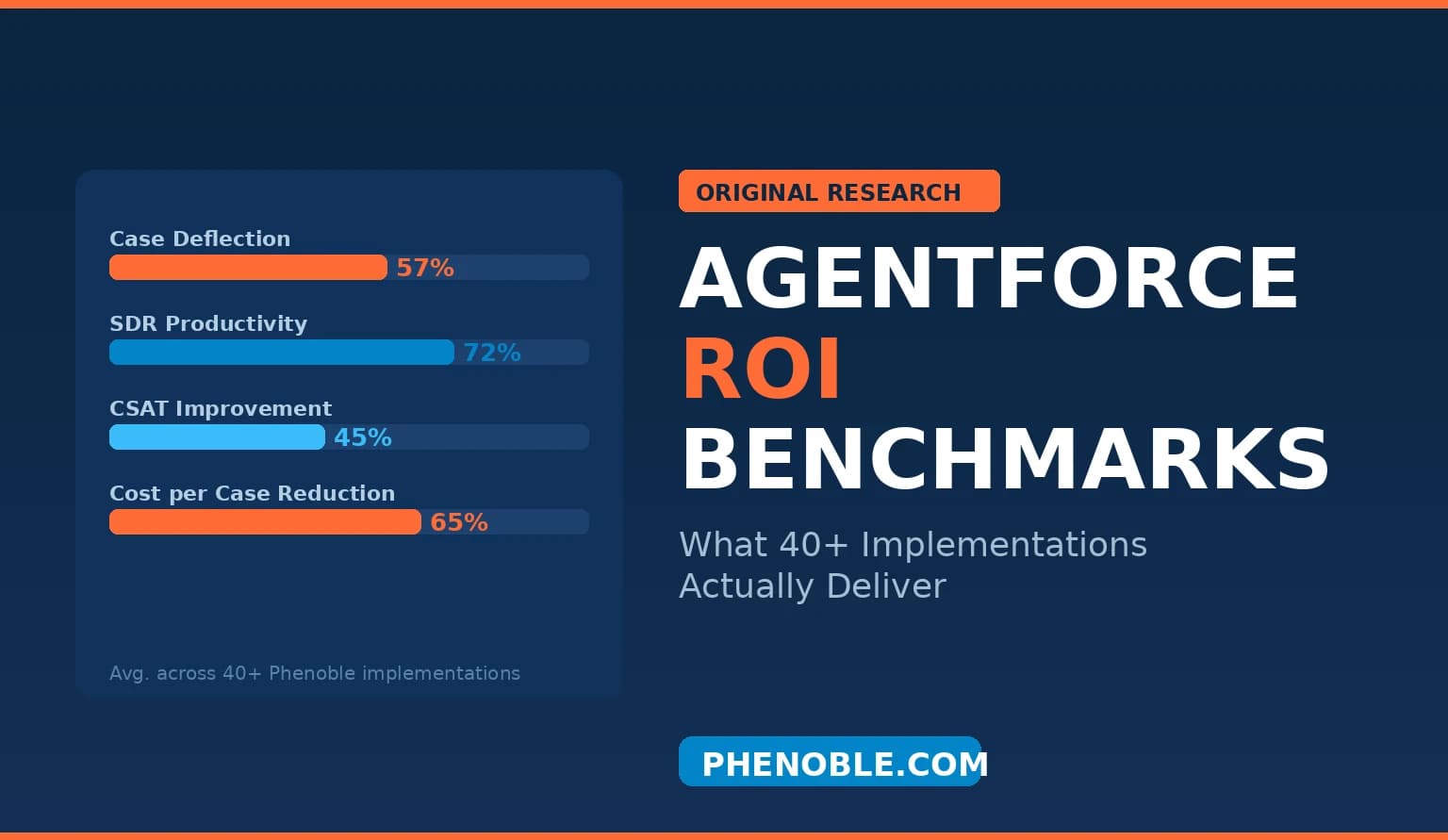
Real Agentforce implementations deliver 38% to 62% case deflection, first response times cut from hours to under 2 minutes, 2.1x to 3.4x more qualified leads worked per SDR, and a first live agent in 6 to 10 weeks. Those are the headline benchmarks; the rest of this post breaks down each one and what drives the variance.
Drawing on 40+ Salesforce implementations, including our Agentforce deployments for clients from nonprofits to B2B manufacturers, we started tracking the same metrics clients ask about in every discovery call. This post consolidates those benchmarks so you can set realistic expectations before you buy, budget, or go-live.
Which Metrics Actually Matter Post-Go-Live?
Salesforce publishes high-level stats. What's harder to find is implementation-level data broken down by use case. Here's what we see across our portfolio.
1. Case Deflection Rate (Service Agents)
Benchmark: 38% to 62% of inbound cases
Service agents are where Agentforce delivers the most measurable ROI. Across deployments using Agentforce for customer service, including password resets, order status, return initiations, and policy lookups, we consistently see between 38% and 62% of cases fully resolved without a human agent touching the ticket.
What drives the variance:
- Knowledge base quality at go-live (the single biggest factor)
- How narrow or broad the agent's topic scope is
- Whether the org uses Data Cloud for personalized context
- Average case complexity (transactional vs. consultative)
Real example: A retail client processing roughly 4,200 monthly service cases went live with a scoped Agentforce agent handling order inquiries and returns. At 60 days post-launch: 44% case deflection, equating to about 73 fewer human-handled cases per week. At an internal cost of $8.20/case, that's roughly $31K annualized savings from one agent topic.
2. First Response Time (Service)
Benchmark: From 4 to 18 hours down to under 2 minutes
This is the easiest win to show leadership. Before Agentforce, first response time in a typical SMB Salesforce org ranges from 4 hours (for orgs with solid triage flows) to 18+ hours (for orgs relying on manual inbox monitoring). After go-live, customers interacting with an Agentforce agent get an immediate, contextual response at any hour.
The key word is contextual. A generic chatbot that says "I'll connect you with an agent" doesn't move this metric. Agentforce with a proper Knowledge base and CRM data connection gives an answer, not a handoff.
3. SDR Productivity (Sales Agents)
Benchmark: 2.1x to 3.4x more qualified leads worked per rep per week
When we configure the Agentforce SDR agent to handle inbound lead qualification, including scoring, initial outreach, and meeting booking, the human SDR shifts from volume work to closing readiness conversations. The reps we've tracked handle between 2x and 3.4x more qualified pipeline touches per week, with no headcount increase.
The uplift is lower, between 1.6x and 2.1x, when the SDR agent is layered onto a messy lead routing setup or when reps aren't trained to work alongside the agent's handoffs. Implementation quality matters.
4. Time to First Value
Benchmark: 6 to 10 weeks from contract to first live agent
One of the most common questions on discovery calls: "How long does this actually take?" The honest answer depends on scope, but here's what we see:
| Deployment scope | Typical time to go-live |
|---|
| Single-topic service agent (narrow) | 6 to 8 weeks |
| Multi-topic service agent + knowledge setup | 9 to 13 weeks |
| SDR agent with Salesforce CRM integration | 8 to 10 weeks |
| Full Agentforce + Data Cloud integration | 14 to 20 weeks |
Timelines lengthen when the org has data quality issues, no existing Knowledge articles, or when stakeholder alignment across IT/Sales/Service is incomplete at project start.
5. Agent Containment vs. Escalation Split
Benchmark: 55% to 70% fully contained / 30% to 45% escalate to human
"Containment" means the customer's issue was resolved entirely by the AI agent with no human intervention. "Escalation" means the agent recognized the limits of its scope and handed off with context.
Free newsletter
Get Agentforce insights delivered weekly
Join 500+ Salesforce pros learning how to deploy AI agents that actually work.
No spam. Unsubscribe any time.
A healthy escalation rate is not a failure: it's a sign the agent is scoped correctly. The red flag is a low escalation rate paired with low CSAT, which usually means the agent is failing silently and customers are abandoning without resolution.
6. CSAT Impact
Benchmark: +6 to +14 points on post-interaction CSAT
This one surprises clients the most. The assumption is that customers dislike AI, but a well-configured Agentforce agent that resolves an issue in under 2 minutes consistently scores higher on post-interaction surveys than a human agent resolving the same issue in 6 hours.
Speed matters. Context matters. The agents that score highest are the ones with access to order history, account data, and well-structured Knowledge; not just a list of FAQs.
What Does Agentforce ROI Depend On? (Honest Assessment)
The benchmarks above are real, but they're not guaranteed. The orgs that hit the top of the range share these traits:
1. Clean CRM data before go-live:
Agentforce pulls from your Salesforce data. If your contact records are incomplete, your account hierarchies are messy, or your product catalog is inconsistent, the agent's responses will reflect that. Data readiness isn't optional.
2. A maintained Knowledge base:
Service agents are only as good as the articles they're grounded in. Orgs that invest in 30 to 60 well-structured Knowledge articles before launch see 2 to 3x better containment rates at 90 days.
3. Defined escalation paths:
The agent needs clear rules for when to hand off and how to pass context to the human agent. Orgs that skip this step see high escalation abandonment, meaning customers dropped mid-conversation.
4. A human in the loop for the first 60 days:
Every org we've worked with improves containment rate by 10 to 18 percentage points between week 2 and week 10 simply by reviewing escalated conversations and updating agent topics. Agentforce gets better when humans monitor and refine it.
How Do These Benchmarks Compare Across Industries?
| Industry | Avg. deflection rate | Avg. time-to-value |
|---|
| Retail / eCommerce | 48% to 62% | 7 to 10 weeks |
| Financial Services | 35% to 50% | 10 to 14 weeks |
| Healthcare / Life Sciences | 30% to 45% | 12 to 18 weeks |
| Manufacturing / Industrial | 38% to 52% | 8 to 12 weeks |
| Nonprofit / Education | 40% to 58% | 6 to 9 weeks |
| Real Estate (brokerage, dev, PM) | Not yet published | 6 to 10 weeks |
Healthcare and financial services trend lower on deflection because regulatory requirements restrict what an AI agent can resolve unassisted, not because Agentforce performs worse in those orgs.
Real estate is the one row without a deflection range, and that is deliberate. Our real estate deployments are recent enough that a published average would be a guess dressed as a benchmark. The time-to-value figure holds because it is scope-driven, not industry-driven: a single lead qualification, listing inquiry, or tenant service agent is the same build shape in real estate as anywhere else. We will publish a deflection range when the sample supports one.
Frequently Asked Questions
Is Agentforce worth it for a small Salesforce org?
It depends on case volume. Below roughly 800 monthly service cases, the ROI math gets tighter, not impossible, but you'll want to model it carefully. Above 1,500 cases/month, the case for Agentforce is almost always clear.
How does Agentforce ROI compare to traditional chatbots?
Traditional chatbots (rule-based) typically deflect 15% to 25% of cases. Agentforce, grounded in real Knowledge and CRM data, consistently delivers 2 to 3x that rate, and with dramatically higher CSAT because it gives real answers instead of "here's a link."
What's the typical payback period?
Across our portfolio, orgs with 2,000+ monthly cases typically see full implementation cost payback within 8 to 14 months. Orgs with lower volume may be 18 to 24 months, depending on licensing costs and implementation scope.
Can I see results before committing to a full implementation?
Yes, and this is actually our recommended approach. A single-topic proof-of-concept agent scoped to your highest-volume case type gives you real containment data in 6 to 8 weeks. We use that data to build the business case for broader deployment.
The Bottom Line
Agentforce ROI is real, but it's not magic. The orgs that hit 60%+ deflection and 3x SDR productivity didn't get there by turning on a feature. They got there with a well-scoped implementation, clean data, and 60 days of active tuning.
If you want to know what the benchmarks look like for your specific org, including case volume, data quality, and use case, our free 30-minute audit is exactly that conversation. We'll tell you where you sit and what realistic outcomes look like before you commit anything.
Explore how we approach Agentforce implementation or review what 40+ deployments have delivered for clients like yours.
